
Why Rameswaram Sea Has No Waves?
The Mystery of the Calm Ocean
Note: In this article, the term Rameswaram Sea refers to the Agni Theertham Sea, located near the sacred Ramanathaswamy Temple in Rameswaram.
Agni Theertham beach in Rameswaram is famous not only for its religious importance but also for its unique calmness. The sea here often looks like a still lake, leaving many pilgrims and tourists wondering: Why does the Rameswaram Sea have no waves or tides?
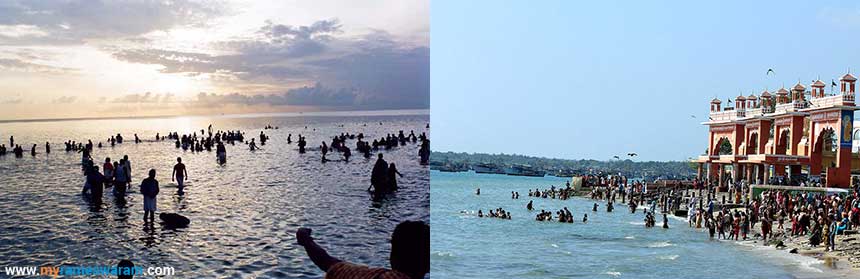
Even local residents of Rameswaram often get asked this question by friends and visitors. In this article, we’ll explore both the scientific reasons and the mythological stories behind this natural wonder.
How Are Waves Normally Formed in the Sea?
Waves in oceans and seas are usually formed by several natural forces. The strength and size of the waves depend on the combination of these factors:
- Wind blowing across the surface of the ocean
- Rotation of the Earth
- The gravitational pull of the Moon
- Ocean currents and water movement
Under unstable weather conditions, storms and cyclones can even create hazardous tidal waves. However, the situation near Agni Theertham in Rameswaram is entirely different.
The Unique Case of Rameswaram Sea
In the Rameswaram region, most beaches such as Dhanushkodi Beach, Kunthukal Beach, and Pamban Beach experience normal tidal waves. But the Agni Theertham Sea remains strikingly calm with very minimal ripples.
Mythological Beliefs
According to local legends, the sea near the Ramanathaswamy Temple remains calm to obey Lord Shiva. Another story suggests that in ancient times, the sea once created massive waves causing destruction in Rameswaram. To pacify it, rituals and offerings were performed, including a symbolic elephant sacrifice. Since then, the sea is believed to have remained peaceful as a mark of respect for the rituals.
Scientific Reasons Why Rameswaram Sea Has No Waves
While myths add cultural significance, science offers practical explanations for this natural phenomenon. The calmness of Agni Theertham is mainly due to the following reasons:
- Geographical Location: The sea here is sheltered and does not face strong oceanic currents.
- Shallow Waters: The area is not very deep or vast, limiting wave formation.
- Protection from Coral Reefs: The nearby coral reefs act as natural barriers, absorbing wave energy and calming the sea.
- Lack of Strong Winds: Since the coast is relatively sheltered, strong winds that normally create waves are absent.
In simple terms: larger the water body, deeper the ocean, and stronger the winds, the bigger the waves. Since the conditions near Agni Theertham don’t support this, the sea appears almost waveless.
Other Calm Beaches Near Rameswaram
Interestingly, Ariyaman Beach (Kushi Beach) near Rameswaram also shows similar calmness with very little wave activity. This makes both Agni Theertham and Ariyaman Beach unique compared to other coastal regions of Tamil Nadu.
Conclusion
The mystery of the calm Rameswaram Sea is a mix of science and spirituality. While coral reefs, shallow waters, and geography explain the natural side, mythology adds a sacred dimension. Whether you visit for faith or curiosity, standing at Agni Theertham and witnessing its stillness is truly a memorable experience.